zostaw wiadomość
Jeśli jesteś zainteresowany naszymi produktami i chcesz poznać więcej szczegółów, zostaw wiadomość tutaj, odpowiemy najszybciej jak to możliwe.

As we all know, when sourcing WPC materials, quality is just as important as price. So, how exactly do you judge the quality of a WPC board? Looking at the surface is simply not enough.
There are dozens of quality standards for WPC products: strength, toughness, water absorption, flame retardancy, anti-corrosion, anti-oxidation, formaldehyde emission, and so on. As a sourcing manager, you can't buy dozens of expensive machines to test all these. Professional factories will regularly send products to third-party testing agencies for certification. However, there are 6 core indicators that must be tested for every batch right here in our own factory lab.
Today, we are going to reveal the most hardcore of the 6 core indicators: Pressure Strength, Water Absorption (72-hour boiling), and Falling Ball Impact. Let's see how a legitimate factory uses these "simple and brutal" methods to filter out 70% to 80% of inferior boards on the market!
Professional Tip:
Before testing, professional factories place samples in a constant temperature and humidity chamber at 23°C and 50% humidity for 24 hours to eliminate environmental variables.
1. Pressure Strength Test: The Lifeline of Load-Bearing and Safety
The most important indicator of a board is its strength, which directly determines the load-bearing capacity and lifespan of the decking outdoors.
How to Test:
Set the spacing of the bottom joists on the machine (usually 35cm; for example, the Korean KS standard is 40cm).
Place the cut WPC board on the joists. Ensure the board is not offset by measuring both ends with a ruler, guaranteeing even stress distribution.
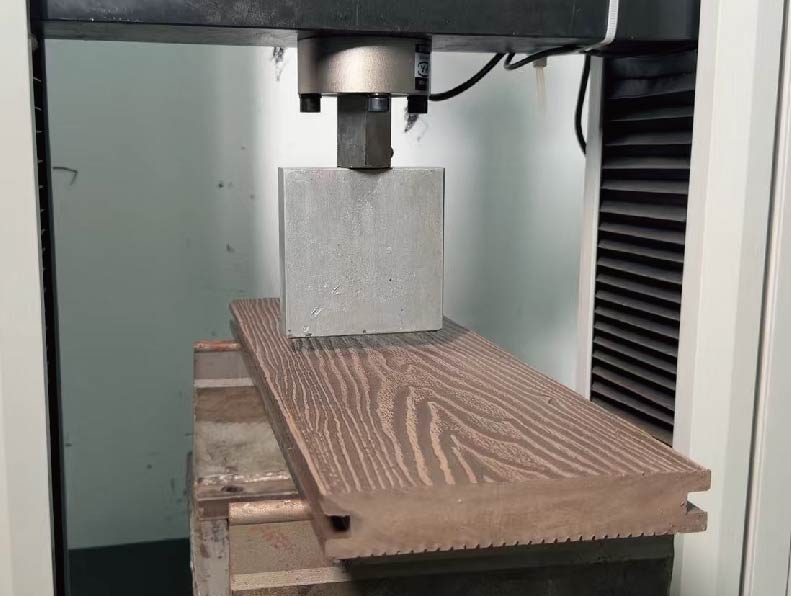
Operate the machine to lower the pressure head slowly. The national standard requires the contact area of the pressure head to be 51mm x 51mm (factories usually prepare different sizes for various country standards).
Observe the peak force value on the screen the moment the board breaks.
Standard:
The national standard requires a compressive strength of 3400N. However, high-quality factory products far exceed this: Hollow decking typically reaches over 3800N, while solid decking can exceed 4400N.
Sourcing Tip: Always ask the factory for a pressure strength test report when sourcing. If they can't even provide this, you need to be very careful before placing an order!
2. 72-Hour Boiling (Water Absorption): The Confidence to Resist Extreme Weather
WPC decking is mainly used outdoors, where it inevitably faces extreme environments like heavy rain and standing water. If the water absorption rate is too high, long-term rain exposure will cause the board to swell and destroy its structural stability.
How to Test:
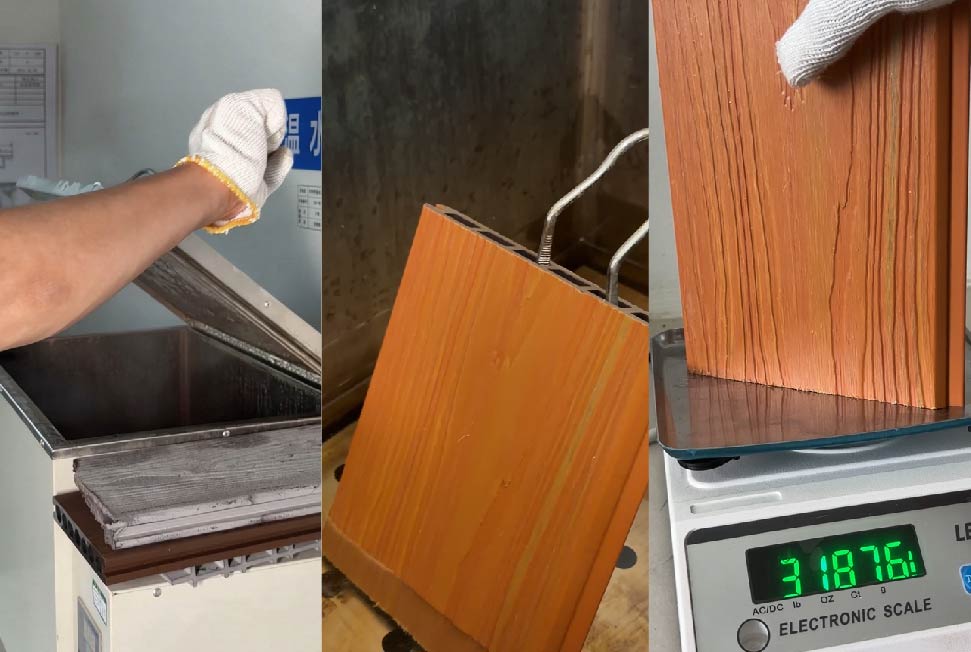
The method is quite straightforward. Place the treated board directly into a boiling water tank, set the temperature to 98°C, and boil it continuously for 72 hours. After taking it out, measure its weight and compare it to the pre-boiling weight to calculate the water absorption rate.
Standard:
The national standard stipulates that the water absorption rate of WPC boards must not exceed 1%. Boards that pass this test can easily handle ordinary outdoor rain without any issues.
3. Falling Ball Impact Test: Testing Surface Hardness and Durability
Outdoor decking inevitably faces falling objects. The simplest way to test if a board is durable is to "smash" it.
How to Test:
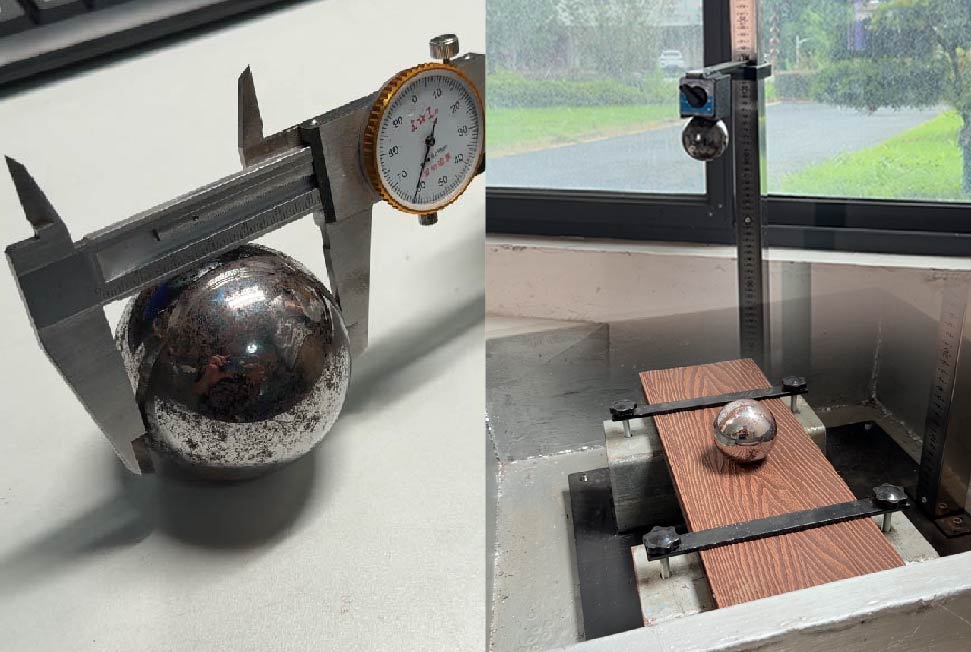
Securely fix the treated board onto the test bench.
Raise the drop point of a steel ball to a height of 1.75 meters.
Turn off the magnetic switch and let the steel ball fall naturally, hitting the board's surface heavily.
Check the damage on the board's surface.
Standard:
The national standard requires the damaged surface area to be less than or equal to 12mm without obvious penetration damage. Truly high-quality boards will show almost no visible damage after such a heavy impact.
Conclusion & Preview
That wraps up the three most hardcore indicators for today: Pressure Strength, Water Absorption, and Falling Ball Impact. Although the testing methods seem simple and brutal, they act as a "magic mirror" that instantly filters out 70% to 80% of inferior boards on the market.
As for the remaining three—Buoyancy Density Test, 24-Hour Bending Creep, and Screw Holding Power—they focus more on the board's "long-term stability" and "installation friendliness." Some manufacturers dare to show you strength reports, but might not dare to show you creep data, because it directly determines whether your outdoor decking will collapse and deform two years from now.
Stay tuned for our next article, where we will take you directly to these three "hidden levels" and reveal how factories control long-term quality. If you are interested, follow us, and let's see the real deal next time!